
Have you ever wondered why your hair behaves so differently from your friends’, family members’, or even your own siblings’? Why does one person’s hair fall in perfect waves while another struggles with frizz, and yet another enjoys sleek, straight locks that rarely need styling? The answer lies in understanding hair types and the incredible diversity of human hair texture. From pin-straight strands to tight coils, every person’s hair tells a unique story written in their genetic code. Yet despite how fundamental hair is to our appearance and identity, many people go through life without truly understanding their specific hair type or how to care for it properly. This lack of knowledge leads to frustration, damaged hair, wasted money on unsuitable products, and missed opportunities to showcase your hair’s natural beauty. Whether you’re dealing with limp, lifeless hair that won’t hold a style, unmanageable curls that seem to have a mind of their own, or anything in between, this comprehensive guide will illuminate everything you need to know. We’ll explore the science behind different hair types, decode the classification system that helps identify your unique texture, reveal the specific needs of each category, and provide actionable care strategies that transform your relationship with your hair. By the end of this guide, you’ll not only understand your hair type but also possess the knowledge to nurture it into its healthiest, most beautiful state.

Understanding the Hair Type Classification System
Before diving into specific hair types, it’s essential to understand the framework that helps us categorize and discuss hair texture systematically. The most widely recognized system was developed by celebrity hairstylist Andre Walker in the 1990s and has since become the standard reference for hair care professionals and enthusiasts worldwide.
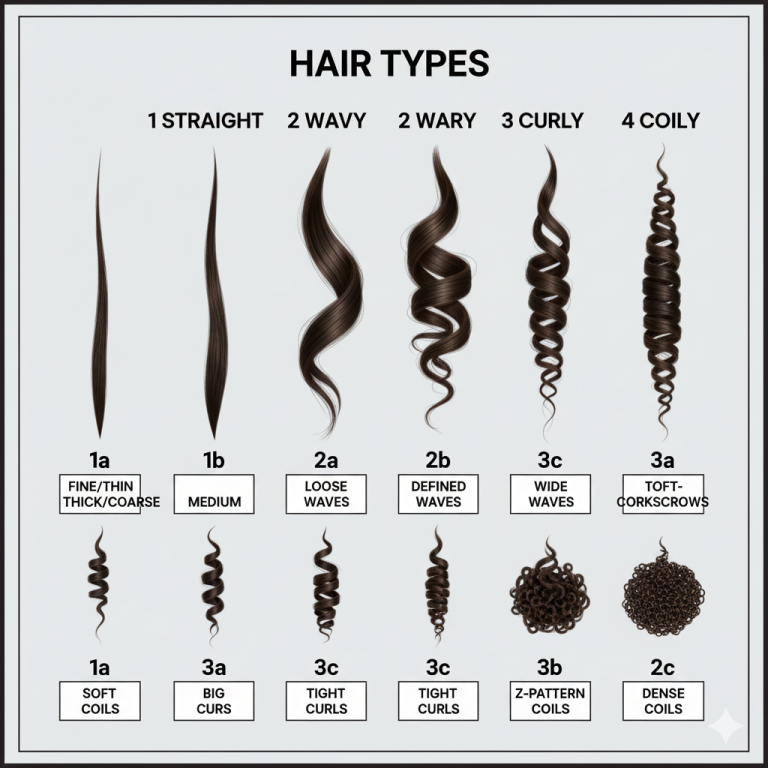
This classification divides hair types into four main categories numbered 1 through 4, with each category further subdivided into three subcategories labeled A, B, and C. The numbers represent the overall texture pattern: Type 1 is straight, Type 2 is wavy, Type 3 is curly, and Type 4 is coily or kinky. The letter subcategories indicate the intensity or tightness of the pattern within each major type.
While no classification system can capture every nuance of human hair diversity, this framework provides a useful common language for discussing hair types. It helps people identify their natural texture, understand their hair’s specific needs, and communicate effectively with stylists and product manufacturers about what works for their particular hair structure.
Understanding where your hair fits within this system empowers you to make informed decisions about products, styling techniques, and care routines. Rather than trying random approaches hoping something works, you can target strategies specifically designed for your hair types and characteristics.
Type 1 Hair: Straight Hair Explained
Type 1 represents completely straight hair without any curl, wave, or bend pattern. This hair type grows directly from the follicle without deviation, creating sleek, smooth strands that reflect light uniformly and often appear shinier than other hair types due to the flat cuticle structure.
Type 1A: Fine and Thin Straight Hair
The finest subcategory of straight hair types, 1A hair features delicate strands with minimal volume and body. This hair is often described as baby-soft and can be challenging to style because it resists holding curls or volume. The fine texture means it gets oily quickly as natural oils from the scalp travel easily down the smooth hair shaft.
People with 1A hair benefit from lightweight products that don’t weigh down their strands. Volumizing shampoos and conditioners formulated for fine hair help create the appearance of thickness without adding heaviness that pulls hair flat against the scalp.
Type 1B: Medium Straight Hair
Type 1B represents medium-textured straight hair with slightly more body and volume than 1A. While still completely straight, these strands have more substance and hold styles somewhat better. This is perhaps the most common straight hair type and generally the easiest to manage among all hair types.
The medium strand thickness provides versatility in styling while maintaining the sleek appearance characteristic of straight hair. Type 1B hair tolerates a wider range of products than 1A without becoming weighed down or greasy.
Type 1C: Coarse Straight Hair
The thickest subcategory of straight hair types, 1C features coarse, resilient strands that resist styling but maintain volume naturally. This hair type can be prone to frizz despite being straight and may feel somewhat wiry or textured even without curls or waves.
Type 1C hair benefits from moisturizing products that smooth the cuticle and reduce frizz while maintaining the natural straight pattern. This hair type often requires more intensive conditioning than finer straight hair types to maintain smoothness and manageability.
Type 2 Hair: Wavy Hair Varieties
Type 2 encompasses wavy hair that falls between straight and curly, characterized by S-shaped wave patterns of varying intensity. Understanding the subcategories of wavy hair types helps identify specific care approaches that enhance natural texture.
Type 2A: Loose Waves
The finest and loosest of wavy hair types, 2A features subtle S-waves that create gentle movement without pronounced definition. This hair sits close to the scalp with minimal volume and can be easily straightened or enhanced into more defined waves with minimal effort.
Type 2A hair requires lightweight products that enhance natural texture without creating heaviness. The wave formation is delicate and easily disrupted by heavy creams or oils that cause the waves to fall flat.
Type 2B: Defined Waves
Medium-textured 2B hair displays more defined S-waves that start closer to the roots and create moderate volume. These waves are more resistant to straightening than 2A and more prone to frizz, particularly in humid conditions.
This hair type benefits from products that provide light to medium hold while controlling frizz. The balance between moisture and definition becomes crucial for maintaining attractive, well-formed waves throughout the day.
Type 2C: Strong Waves
The coarsest and most defined of wavy hair types, 2C features prominent S-waves that border on curly territory. These waves begin at or near the roots, create significant volume, and often include some spiral formations, particularly in underlayers.
Type 2C hair responds well to techniques and products used for curly hair, including curl-enhancing creams, diffusing, and moisture-rich formulations. This hair type requires more attention to hydration and definition than looser wave patterns.
Type 3 Hair: Curly Hair Categories
Type 3 represents curly hair with well-defined spiral or ringlet patterns. These hair types have distinctly different needs from straight and wavy textures, requiring specialized care approaches that honor the curl structure.
Type 3A: Loose Curls
The loosest of curly hair types, 3A features large, loose curls approximately the circumference of sidewalk chalk. These curls have a defined S-pattern that forms springy ringlets with natural shine and considerable movement.
Type 3A hair benefits from lightweight curl-defining products that enhance natural curl pattern without creating heaviness or crunchiness. Maintaining moisture balance prevents frizz while preserving the natural bounce and definition of the curls.
Type 3B: Medium Curls
Medium-textured 3B curls are tighter than 3A, approximately the circumference of a marker. These curls form well-defined spirals with more volume and less natural shine than looser curl types. The tighter curl structure makes hair more prone to dryness and frizz.
Type 3B hair requires rich moisturizing products, regular deep conditioning treatments, and techniques like finger coiling or shingling to enhance curl definition. The hair structure needs consistent hydration to maintain elasticity and prevent breakage.
Type 3C: Tight Curls
The tightest curly hair type, 3C features densely packed corkscrew curls approximately the circumference of a pencil or straw. These curls create maximum volume and a fuller appearance but are highly susceptible to dryness, shrinkage, and tangling.
Type 3C hair demands intensive moisture, protein treatments for strength, and gentle detangling methods. This hair type benefits from leave-in conditioners, curl creams, and protective styling that minimizes manipulation and mechanical damage.

Type 4 Hair: Coily and Kinky Hair
Type 4 represents the tightest curl patterns, often called coily or kinky hair. These hair types feature zigzag or tightly coiled patterns that create maximum shrinkage and require the most specialized care approaches among all hair types.
Type 4A: Soft Coils
Type 4A features tightly coiled S-pattern curls approximately the circumference of a crochet needle. These coils are well-defined and springy with a softer texture than other Type 4 subcategories. The tight coil pattern creates significant shrinkage, sometimes up to 75% of the actual hair length.
This hair type requires intensive moisture through rich butters, oils, and creams. The coil structure makes it challenging for natural oils to travel from scalp to ends, necessitating regular deep conditioning and moisturizing treatments.
Type 4B: Z-Pattern Coils
Type 4B hair forms a distinct zigzag pattern rather than defined spirals, creating sharp angles and bends along the hair shaft. This texture has less defined curl clumps than 4A and experiences even more dramatic shrinkage, making hair appear much shorter than its actual length.
Type 4B requires maximum moisture retention, protective styling to minimize breakage, and extremely gentle handling during detangling. The texture pattern makes this hair type particularly fragile when dry, demanding consistent hydration and careful manipulation.
Type 4C: Densely Packed Coils
The tightest of all hair types, 4C features densely packed coils with minimal visible curl definition. The zigzag pattern is so tight that individual coils may not be visible, creating a cotton-like texture. This hair type experiences the most dramatic shrinkage and is the most fragile, requiring extraordinary care.
Type 4C hair benefits from the LOC (liquid, oil, cream) or LCO method of moisturizing, protective styles that minimize daily manipulation, and satin or silk coverings to prevent moisture loss. Understanding and honoring the unique needs of this hair type is essential for maintaining healthy growth and preventing breakage.
The Science Behind Different Hair Types
Understanding why different hair types exist requires examining the biological factors that determine texture. The shape of hair follicles, the distribution of protein bonds within the hair shaft, and genetic inheritance all contribute to creating the diverse range of hair types humans express.
Hair follicles determine the fundamental texture category. Perfectly round follicles produce straight Type 1 hair, while increasingly oval or asymmetrical follicles create progressively curlier patterns through Types 2, 3, and 4. The degree of follicle asymmetry directly correlates with curl tightness.
Disulfide bonds—chemical connections between sulfur atoms in hair protein molecules—also influence texture. These bonds create the curves, bends, and coils characteristic of different hair types. Straight hair has fewer or differently distributed bonds compared to curly and coily textures where numerous bonds create the characteristic patterns.
Genetic factors represent the primary determinant of hair types, with multiple genes influencing texture, thickness, density, and growth patterns. This explains why hair types often run in families and why siblings may have similar but not identical textures depending on which genetic variants they inherit.
Environmental factors, health conditions, hormonal changes, and aging can influence how prominently your natural hair type expresses itself, but these factors modify rather than fundamentally change your genetically determined texture. A person with Type 3 hair may notice their curls loosen or tighten due to hormones or health changes, but they won’t spontaneously develop Type 1 straight hair without chemical intervention.

Porosity: The Critical Factor Across All Hair Types
While texture classification helps identify hair types, understanding porosity—your hair’s ability to absorb and retain moisture—is equally crucial for proper care across all categories. Porosity affects how your hair responds to products, treatments, and environmental conditions regardless of whether you have straight, wavy, curly, or coily hair.
Low porosity hair has tightly closed cuticles that resist moisture absorption. Products tend to sit on the hair surface rather than penetrating. This hair type benefits from lightweight products, heat during deep conditioning to open cuticles, and humectants that help moisture penetrate.
Medium porosity represents the ideal balance where cuticles are slightly raised, allowing moisture to enter and remain within the hair shaft with relative ease. This hair type maintains moisture balance naturally and responds well to most products and treatments.
High porosity hair features raised or damaged cuticles that absorb moisture rapidly but lose it equally quickly. This commonly results from chemical processing, heat damage, or environmental stress. High porosity hair types require protein treatments for strength, heavy sealants to trap moisture, and products rich in oils and butters.
Testing your porosity helps refine your care approach within your texture category. A simple float test—placing a clean strand in water and observing whether it floats (low porosity), hovers mid-water (medium), or sinks quickly (high porosity)—provides basic porosity information that enhances your understanding of your specific hair needs.
Density and Thickness Considerations
Beyond texture patterns and porosity, understanding hair density (how many strands you have) and individual strand thickness affects care approaches across all hair types. These characteristics influence product selection, styling techniques, and how your hair responds to various treatments.
Low density means fewer hair follicles per square inch of scalp, creating hair that may appear thin or sparse regardless of texture type. High density indicates numerous follicles creating thick, full hair. Medium density falls between these extremes and represents the most common distribution.
Individual strand thickness—fine, medium, or coarse—operates independently of density. You can have high-density fine hair (many thin strands) or low-density coarse hair (fewer thick strands). Understanding both factors helps identify why your hair behaves as it does.
Fine hair across all hair types benefits from volumizing products and techniques that create the appearance of fullness without weighing strands down. Coarse hair requires more moisture and stronger hold products to manage and style effectively. Medium thickness tolerates the widest range of products and techniques.
Combining knowledge of your texture type, porosity level, density, and strand thickness creates a comprehensive profile that guides personalized hair care decisions. This holistic understanding explains why two people with the same texture classification may need different approaches based on these additional variables.
Universal Hair Care Principles
Despite the diversity of hair types, certain fundamental care principles apply universally, creating the foundation for healthy hair regardless of texture category.
Gentle cleansing protects all hair types from damage and excessive dryness. Harsh sulfates strip natural oils that protect and nourish hair, regardless of whether you have Type 1 or Type 4 texture. Sulfate-free cleansers or cleansing conditioners maintain scalp health while preserving beneficial oils.
Conditioning replenishes moisture and smooths cuticles across all hair types, though the intensity and type of conditioning varies by texture. Straight hair may need only light conditioning focused on ends, while coily hair types require rich, intensive conditioning from roots to tips.
Regular trimming removes split ends and maintains hair health universally. The recommended frequency varies—straighter hair types may trim every 8-12 weeks while curlier textures can often wait 12-16 weeks—but the principle applies to all.
Protecting hair from heat damage, mechanical stress, environmental factors, and chemical processing preserves the integrity of all hair types. While the specific protective measures differ by texture, the underlying principle of minimizing damage remains constant.
Adequate hydration, balanced nutrition, stress management, and overall health impact hair quality across all categories. Healthy hair grows from a healthy body, making lifestyle factors relevant regardless of your specific hair type classification.

Specialized Care for Straight Hair Types
Type 1 hair benefits from approaches that add volume, prevent oiliness, and maintain sleek appearance without creating limpness or greasiness.
Volumizing products containing ingredients like rice protein or collagen temporarily thicken hair strands and create lift at roots. These formulations work particularly well for fine Type 1A and 1B hair that naturally lacks body.
Dry shampoo extends time between washes for straight hair types that become oily quickly. The powder absorbs excess oil at the scalp while adding texture and volume that helps styles hold longer.
Heat protectants are crucial when using styling tools to create waves, curls, or added volume in naturally straight hair. The sleek cuticle structure of Type 1 hair can show heat damage more visibly than textured types, making protection essential.
Lightweight serums containing silicones smooth frizz and add shine to straight hair types without creating greasiness. A small amount distributed through mid-lengths and ends enhances the natural sleekness of Type 1 textures.
Specialized Care for Wavy Hair Types
Type 2 hair requires approaches that enhance natural wave patterns while controlling frizz and preventing both flatness and excessive volume.
Wave-enhancing products formulated specifically for Type 2 hair provide the perfect balance of moisture and hold. These typically include light gels, mousses, or creams that define waves without creating the crunch or weight associated with products designed for curlier textures.
Scrunching techniques encourage wave formation by physically encouraging the S-pattern to develop fully as hair dries. Combined with appropriate products, this simple method dramatically improves wave definition across all Type 2 subcategories.
Diffusing accelerates drying while enhancing volume and definition for wavy hair types. The diffuser attachment distributes air flow evenly, preventing the disruption to wave patterns that occurs with direct heat application.
Avoiding brushing dry wavy hair prevents disruption of wave patterns and reduces frizz. Instead, detangle when wet with conditioner applied, using fingers or wide-tooth combs to gently work through knots.

Specialized Care for Curly Hair Types
Type 3 hair demands moisture-focused approaches that define curls, prevent frizz, and maintain the health of the spiral structure.
Curl-defining creams provide moisture and hold specifically calibrated for curly hair types. These products typically contain moisturizing ingredients like shea butter, coconut oil, or aloe vera combined with holding agents that maintain curl formation.
The squish to condish method—adding extra water to conditioner-coated hair and squishing it into the hair repeatedly—helps curly hair types absorb maximum moisture during washing. This technique is particularly effective for Types 3B and 3C.
Plopping uses a t-shirt or microfiber towel to remove excess water while supporting curl formation. This method prevents the downward pull that traditional towel drying creates, helping curls maintain their shape and reducing drying time.
Refreshing curls between wash days with water mixed with leave-in conditioner revives definition without full washing. This approach works well for all Type 3 subcategories and extends time between wash days while maintaining attractive curl appearance.
Specialized Care for Coily Hair Types
Type 4 hair requires the most intensive moisture and gentle handling among all hair types due to the tight coil structure and natural fragility.
The LOC method—applying liquid (water or leave-in), oil, and cream in sequence—layers moisture products to maximize retention in coily hair types. This technique addresses the challenge of moisture traveling along the tightly coiled structure.
Protective styling including braids, twists, and updos minimizes daily manipulation that can cause breakage in Type 4 hair. These styles also help retain moisture and protect ends from environmental damage.
Pre-pooing—applying oil or conditioner before shampooing—helps Type 4 hair types retain moisture during the cleansing process. This pre-treatment prevents the excessive dryness that coily hair experiences from even gentle cleansers.
Finger detangling with generous amounts of conditioner provides the gentlest approach for managing tangles and knots in coily hair types. This method allows you to feel knots and work them out carefully without the tearing that combs or brushes can cause.
Hair Restoration Considerations for Different Hair Types
When hair loss affects individuals across the spectrum of hair types, understanding how texture influences restoration procedures becomes crucial for achieving natural-looking results.
Different hair types present unique challenges during transplantation. Straight Type 1 hair offers easier extraction and implantation due to the perpendicular follicle angle, while curly and coily hair types require specialized techniques that account for curved follicle structures beneath the scalp surface.
Extraction precision varies significantly based on texture. Type 3 and Type 4 hair demand modified punch sizes, angles, and approaches to prevent follicle transection during harvesting. Surgeons experienced in diverse hair types understand these technical adjustments necessary for optimal results.
The aesthetic considerations also differ dramatically. Creating natural-looking hairlines requires understanding how different hair types grow, settle, and frame the face. Type 4 hair’s density and texture characteristics, for example, allow for different coverage patterns than Type 1 or Type 2 hair.
Hair Restoration Excellence in Turkey
Turkey, particularly Istanbul, has emerged as a global leader in hair restoration that successfully addresses diverse hair types. The country’s medical tourism infrastructure and high procedure volumes have created exceptional expertise across all texture categories.
Turkish hair restoration centers perform thousands of procedures annually on international patients representing every possible hair type combination. This extensive experience with diverse textures creates surgical teams capable of handling the specific challenges presented by straight, wavy, curly, and coily hair with equal proficiency.
Advanced techniques adapted for different hair types ensure optimal results regardless of natural texture. Surgeons understand the varying follicle angles, extraction requirements, and aesthetic considerations that each hair type demands for successful restoration.

Este Favor: Expertise Across All Hair Types
Among Istanbul’s numerous hair restoration options, Este Favor has distinguished itself through demonstrated excellence with the complete spectrum of hair types. This hair restoration center’s comprehensive experience encompasses the unique requirements of every texture category from Type 1 through Type 4.
The medical team at Este Favor understands that successful restoration depends on recognizing and honoring each patient’s natural hair characteristics. Their approach begins with detailed analysis of texture type, curl pattern, density, and growth characteristics to develop customized treatment plans.
Este Favor’s surgeons have refined techniques for extracting and implanting follicles across all hair types, from the straightforward perpendicular angles of Type 1 hair to the complex curved structures of Type 4 coils. This specialized expertise ensures graft survival rates and natural-looking results regardless of texture.
The center’s commitment to natural aesthetics means transplanted hair blends seamlessly with existing hair, respecting the patient’s original texture and growth patterns. Whether working with fine straight hair, defined waves, springy curls, or tight coils, Este Favor’s team creates results that honor the patient’s natural appearance.
International patients with diverse hair types benefit from Este Favor’s all-inclusive packages that eliminate logistical concerns. The center provides comprehensive support including airport transfers, accommodation, multilingual assistance, and detailed aftercare guidance specific to each patient’s hair type.
The affordability of procedures in Turkey compared to Western countries—typically 60-75% less expensive—makes Este Favor accessible to individuals who might find restoration financially prohibitive in their home countries. This cost advantage doesn’t reflect compromised quality but rather favorable economic factors that benefit international patients.
For anyone experiencing hair loss regardless of their position on the hair type spectrum, Este Favor’s proven expertise with diverse textures, patient-centered approach, and commitment to natural results make it a trusted choice for restoration procedures in Istanbul.
Product Selection Guidelines for Your Hair Type
Choosing appropriate products requires understanding your specific hair type within the broader classification system and selecting formulations that address your texture’s unique needs.
Type 1 hair benefits from volumizing and lightweight formulations that don’t weigh down strands or create excessive oiliness. Look for products labeled for fine or straight hair that add body without residue.
Type 2 hair requires products that balance moisture and hold without heaviness. Wave-enhancing formulations, light gels, and mousses typically work well across the subcategories of wavy hair types.
Type 3 hair demands moisture-rich products including curl creams, leave-in conditioners, and oils that define curls while preventing frizz. Products containing shea butter, coconut oil, and glycerin work particularly well.
Type 4 hair needs the most intensive moisture products including thick creams, butters, and oils. The tightest coil patterns benefit from rich formulations that might be too heavy for other hair types but provide essential moisture for coily textures.
Reading ingredient lists helps identify whether products suit your hair type. Humectants like glycerin draw moisture for curly and coily hair, while proteins strengthen all hair types, and silicones smooth and protect straight and wavy textures.

Conclusion
Understanding the complete landscape of hair types empowers you to provide the specific care your unique texture needs and deserves. From the sleek simplicity of Type 1 straight hair through the versatile waves of Type 2, the defined curls of Type 3, and the intricate coils of Type 4, each texture category possesses distinct characteristics and requirements that influence every aspect of hair care.
The diversity of hair types reflects the beautiful complexity of human genetics and the remarkable ways our biology expresses itself. Rather than viewing certain textures as more challenging or desirable than others, embracing your natural hair type and learning to care for it properly unlocks its full potential and beauty.
Whether you have fine straight strands that need volume, wavy hair seeking definition, springy curls requiring moisture, or tight coils demanding intensive care, the principles outlined in this guide provide the foundation for developing an effective, personalized routine. Combined with understanding of your specific porosity, density, and strand thickness, this knowledge creates a comprehensive approach to achieving your healthiest, most beautiful hair.
For those experiencing hair loss, understanding how your specific hair type influences restoration procedures helps you make informed decisions and choose qualified professionals experienced with your texture. The expertise available in centers like Este Favor demonstrates that successful restoration is possible across all hair types when procedures are performed by knowledgeable teams who understand the unique requirements of diverse textures.
Your hair type is an integral part of your identity and appearance. By understanding its characteristics, needs, and optimal care approaches, you transform your relationship with your hair from frustration to appreciation, from fighting your natural texture to celebrating it. Armed with this comprehensive knowledge, you’re now equipped to nurture your specific hair type into its healthiest, most vibrant expression.
